By: Austin T. Richey, Digital Media Manager & Storyteller for Detroit Opera
At the center of Tosca are three people who want very different things.
That sounds simple enough. Opera is full of people wanting things: love, revenge, forgiveness, freedom, power, recognition, escape. But Giacomo Puccini’s Tosca is unusually efficient in the way it brings those desires into conflict. There are no sprawling subplots, no long stretches away from the central action, no secondary romance to soften the drama. Instead, Puccini gives us a singer, a painter, and a police chief—and uses them to create one of the most intense collisions in the operatic canon.
Floria Tosca wants love, safety, and spiritual meaning in a world that seems increasingly hostile to all three. Mario Cavaradossi wants freedom—not only for himself, but for a political future larger than himself. Baron Scarpia wants control: over the State, over his enemies, over the law, and, most dangerously, over Tosca.
The drama between them is sometimes described as a love triangle, but that phrase does not quite capture the stakes. Tosca and Cavaradossi love each other. Scarpia wants possession. Cavaradossi believes in political liberation. Scarpia believes in domination. Tosca believes that love and faith should offer protection, only to discover that both can be manipulated by those in power.
Puccini turns a diva, a painter, and a police chief into a study of art, desire, belief, and brutality.
Tosca: The Diva as Believer
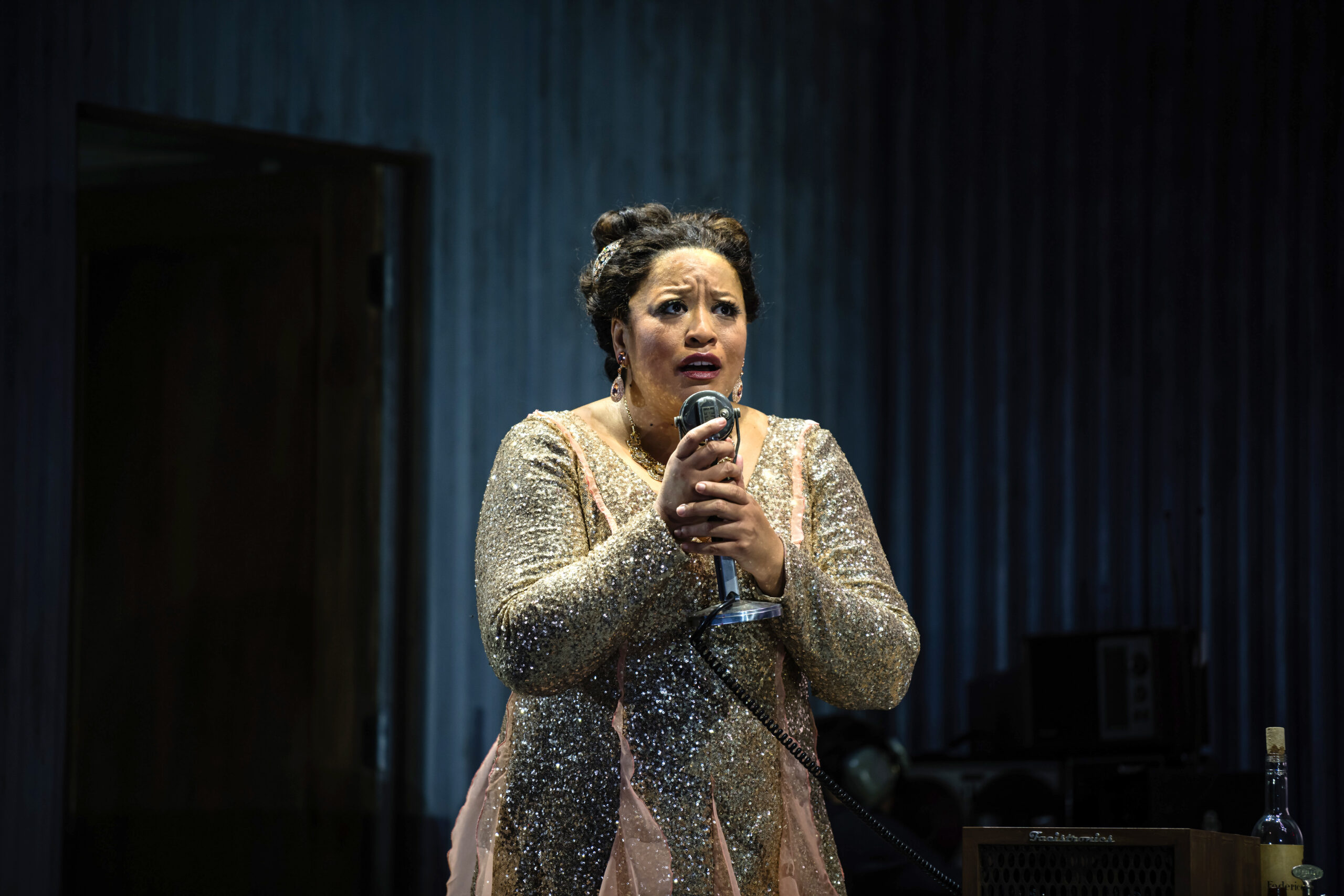
Floria Tosca is one of opera’s great roles, but also one of its most misunderstood heroines. She is a celebrated singer, deeply religious, passionately in love, and accustomed to public attention. She is also jealous, impulsive, tender, theatrical, courageous, and vulnerable. In lesser hands, Tosca could become a stereotype: the temperamental diva, the overly emotional woman, the jealous lover who causes trouble before realizing too late what is at stake. But Puccini gives her something far more complicated.
Tosca’s emotions are real, and they are not trivial: jealousy, faith, love. Her jealousy matters because Scarpia knows how to use it. Her faith matters because the world around her violates the moral order she believes in. Her love matters because it becomes the very thing through which she is trapped. And then there’s her celebrity—public women are visible, desired, judged, and vulnerable.
Opera is full of women whose emotional lives are larger than the worlds built to contain them. Violetta in Verdi’s La traviata is judged for her public life and punished for her private sincerity. Norma in Bellini’s Norma is priestess, lover, mother, and political figure all at once, forced to carry contradictions that would destroy a simpler character. Cio-Cio-San in Puccini’s Madama Butterfly believes so completely in love and honor that her faith becomes unbearable to witness. Desdemona in Verdi’s Otello is innocent; her gentleness becomes devastating because it exists inside a world poisoned by suspicion.
Tosca belongs among these figures, but she is distinct. She is not fragile in the same way as Mimì in La bohème. She is not self-sacrificing in the same way as Liù in Turandot. She is not doomed by illness, poverty, or myth. Tosca is a woman of action. She acts. She argues. She demands. She prays. She kills.
Tosca’s best-known aria, “Vissi d’arte,” is central to understanding her. The aria is often heard as a beautiful showpiece, and it is. But dramatically, it is a crisis. Tosca asks why, after living for art and love, she has been repaid with suffering. She is not making a polite statement of belief. She is confronting the apparent failure of the moral universe. That is what makes the aria so powerful. Tosca is not simply asking God to help her. She is asking why goodness has not protected her, why art has not elevated the world beyond cruelty, why love has brought her to the mercy of a predator.
One of the great things opera can do is to stop time when a character has reached the point where ordinary speech is no longer enough. Tosca’s prayer does not solve anything. It gives us access to the depth of the wound. Tosca’s prayer sits alongside some of the repertoire’s most profound moments of spiritual address: Leonora’s prayers in Il trovatore and La forza del destino, Desdemona’s “Ave Maria” in Otello, and the final religious terror of Poulenc’s Dialogues des Carmélites. These moments do not present faith as simple comfort. They test the very limits of faith.
Tosca is not a symbol of perfect virtue. She is more complex: someone whose most human qualities—love, jealousy, fear, devotion—are turned against her. Her tragedy is not that she feels too much. Her tragedy is that Scarpia knows exactly how to weaponize what she feels.
Cavaradossi: The Artist as Dissident
Mario Cavaradossi enters Tosca as a painter at work in a church. That detail matters.
He is an artist, but not an artist removed from the world. He paints sacred imagery while helping a political prisoner escape. He loves Tosca while risking his life for someone else’s freedom. He is at home in beauty, but he is also committed to action.
Cavaradossi can be easy to underestimate because, in many productions, he is framed primarily as the romantic tenor: handsome, passionate, doomed, and blessed with one of Puccini’s most beloved arias, “E lucevan le stelle.” But Cavaradossi is not only Tosca’s lover. He is a political man whose choices bring the machinery of the state into the opera’s private world.
When he helps Angelotti, the escaped prisoner, he knows the danger. This is not a casual favor. It is an act of resistance. His studio, his church, his home, and his romance all become vulnerable because he refuses to remain neutral.
Opera has long been fascinated by artists and idealists who discover that private life cannot be separated from public crisis. In Beethoven’s Fidelio, Florestan is imprisoned after speaking out against tyranny. In Verdi’s Don Carlo, personal love is crushed beneath the weight of empire, church authority, and political duty. In Wagner’s Die Meistersinger von Nürnberg, art becomes a way of debating tradition, innovation, and civic identity. In Mussorgsky’s Boris Godunov, the individual voice is swallowed by history, rumor, and power.
Cavaradossi stands within this broader operatic tradition: the artist whose work is not isolated from politics. His painting is not propaganda, but his life is political because the world around him has made neutrality impossible.
That is one reason Tosca feels so modern. Artists often want to believe that beauty can exist apart from power. Puccini is not so sure. Cavaradossi’s art does not protect him. His talent does not exempt him. The church in which he paints is not sealed off from surveillance. His love affair is not safe from the state. Even his private gestures can be read as evidence.
His final aria, “E lucevan le stelle,” is often treated as a tenor’s great romantic farewell, but it is more than that. Cavaradossi is remembering sensual life at the moment he is about to lose it: stars, scent, touch, kisses, the beauty of the world. The aria is devastating because it does not make him less political; it makes his politics human. He is not dying for an abstraction. He is a person who loves life and still chooses to risk it. Rather than becoming grand or rhetorical, Cavaradossi’s conviction is intimate. He loves Tosca. He loves art. He loves freedom. He loves the physical world. His tragedy is that these loves cannot be separated.
Scarpia: The Villain as Institution
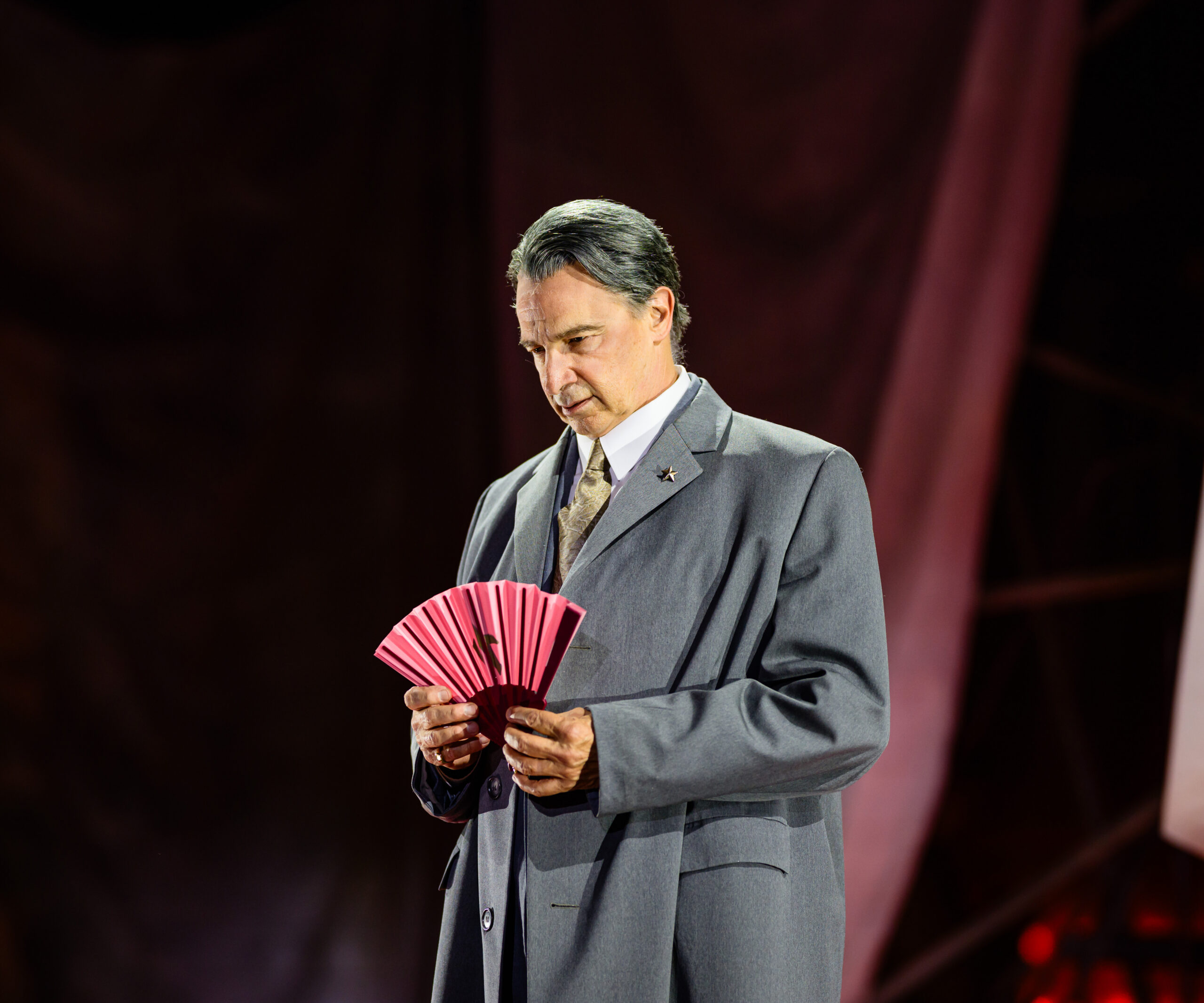
Then there is Baron Scarpia. Opera has no shortage of villains. Some are seductive, some ridiculous, some terrifying, some supernatural. Don Giovanni destroys lives through appetite and entitlement. Iago in Verdi’s Otello turns language into poison. The Grand Inquisitor in Don Carlo represents religious and political authority at its most suffocating. Pizarro in Beethoven’s Fidelio uses imprisonment to hide corruption. Klingsor in Wagner’s Parsifal twists desire into a weapon. Scarpia belongs among the most chilling of them because he is not merely a bad man. He is a bad man with an office.
As chief of police, Scarpia represents official power. He has soldiers, documents, informants, prisons, procedures, and the authority of the state behind him. But Puccini makes clear that Scarpia’s cruelty is also deeply personal. He wants to capture Angelotti. He wants to destroy Cavaradossi. But above all, he wants Tosca. That combination—public authority and private appetite—is what makes him so frightening.
Scarpia knows how to produce fear. He knows how to turn suspicion into evidence. He knows how to manipulate Tosca’s jealousy, Cavaradossi’s courage, and the church’s sacred atmosphere. At the end of Act I, as the Te Deum fills the church, Scarpia sings of his desire for Tosca. The moment is shocking not because it juxtaposes religion and lust, but because it shows how easily institutions can be used as cover for corruption. The public ritual continues. The music swells. The church fills with ceremonial grandeur. And inside it, Scarpia’s private violence grows.
Scarpia is immediately recognizable: the powerful man who believes the rules exist for him to use, not obey. He is also a brilliant example of how opera can make villainy structural. Puccini’s Scarpia does not skulk around the edges of the drama. He dominates space. When Scarpia enters, the temperature of the opera changes. He brings the sound of surveillance with him. Everyone else must react. This makes him different from a purely personal rival. Scarpia is not simply jealous of Cavaradossi. He does not merely want Tosca’s affection. He wants to prove that power can bend love, faith, law, and truth to its will.
Calling Tosca a love triangle feels insufficient. A love triangle suggests competing desire, but Tosca gives us something more brutal: the collision of love and domination. Tosca and Cavaradossi share a relationship, however imperfect and passionate. Scarpia seeks possession. His desire is inseparable from coercion. In Act II, this collision becomes almost unbearable. Cavaradossi is tortured offstage while Tosca is forced to listen. Scarpia does not only inflict pain; he stages pain. He turns Tosca’s love into an instrument of interrogation. He understands that the sound of Cavaradossi’s suffering may break her faster than violence against her own body. This is Puccini at his most theatrically ruthless. We do not need to see the torture. Seeing Tosca hear it is enough.
Not a Triangle, but a Trap
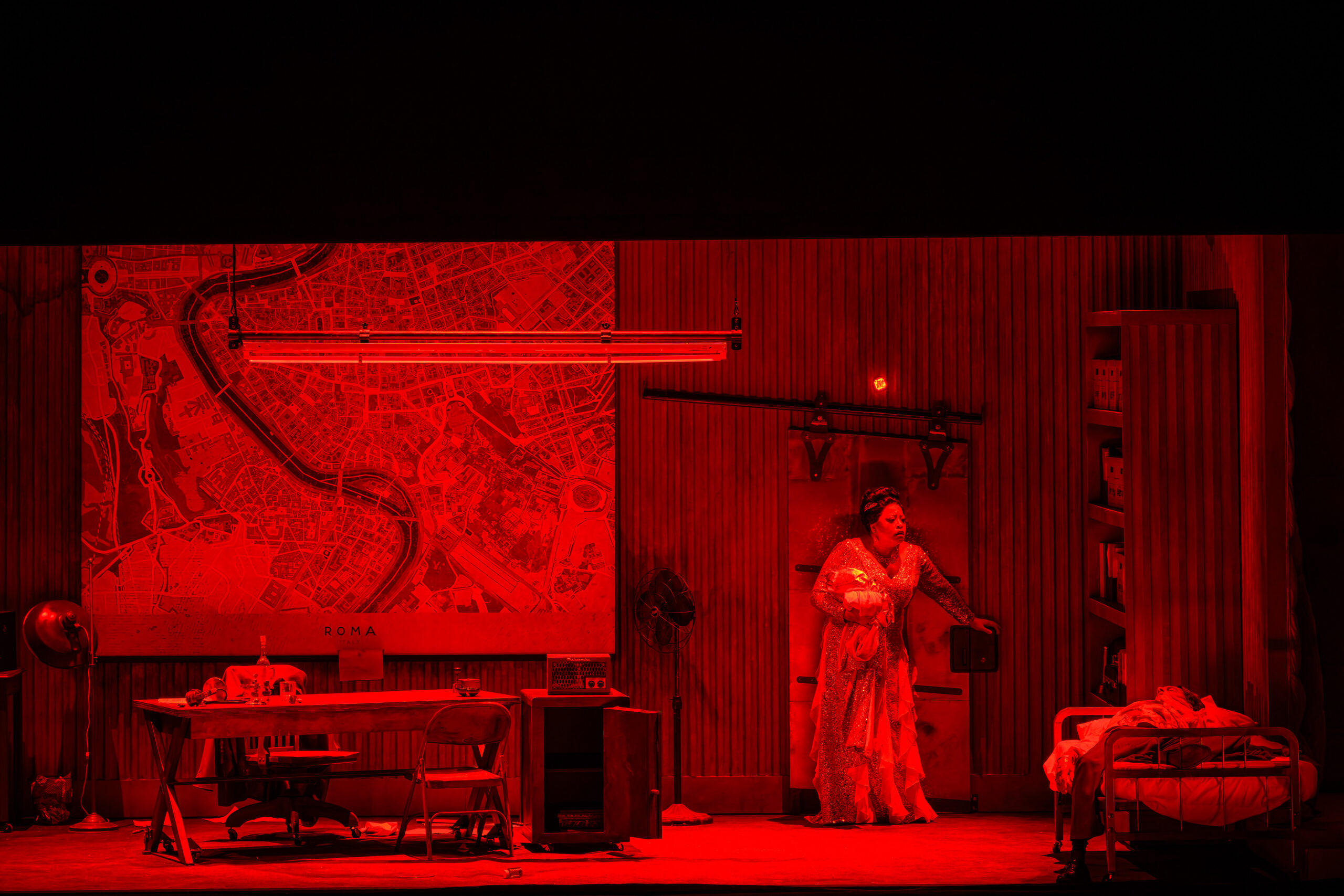
The power of Tosca lies in how tightly these three characters are bound together. Tosca’s love for Cavaradossi makes her vulnerable to Scarpia. Cavaradossi’s politics place him in Scarpia’s path. Scarpia’s authority allows him to manipulate them both. Each character reveals something about the others. Tosca reveals Cavaradossi’s tenderness, but also his recklessness. Cavaradossi reveals Tosca’s devotion, but also her fear. Scarpia reveals the danger surrounding them both. He turns their private lives into state business.
This is why Tosca moves with such force. The opera does not depend on misunderstanding alone, though misunderstanding is important. It depends on pressure. Every choice narrows the next choice. Every act of love creates another point of vulnerability. Every attempt at freedom provokes another act of control.
Tosca is unusually direct. It gives us three acts, three locations, and three central figures. A church. A palace. A prison. A singer. A painter. A police chief. Faith, art, and power. The entire drama takes place in a single 24-hour period. Puccini needs very little else.
Art, Desire, Belief, and Brutality
Part of Tosca’s enduring relevance is that its characters are immediately recognizable, but never simple. We understand Tosca’s jealousy, even when we see how dangerous it becomes. We understand Cavaradossi’s courage, even when we fear its consequences. We understand Scarpia’s power, even as we recoil from his cruelty. These are not abstract figures arranged in a museum of operatic types. They are volatile, embodied people whose desires collide in real time. At the same time, each character carries symbolic weight. Tosca is art and faith under threat. Cavaradossi is beauty and political conviction made vulnerable. Scarpia is state power corrupted by appetite.
Together, they create a drama that feels both intimate and enormous. The story is centered on one woman, one man, and one villain. It also demonstrates what happens when institutions fail, when violence hides behind legitimacy, and when private love becomes entangled with public terror.
That may be why Tosca remains one of the most accessible operas for new audiences and one of the most rewarding for longtime listeners. Its plot is clear, its emotions are immediate, and its music is unforgettable. Beyond that, this is a work of extraordinary moral complexity. Puccini does not give us saints and sinners. He gives us people under pressure. Tosca is capable of jealousy, tenderness, prayer, and violence. Cavaradossi is capable of love, sensuality, bravery, and defiance. Scarpia is capable of charm, calculation, hypocrisy, and brutality. Their world is heightened, but not unfamiliar.
A diva, a painter, and a police chief: One believes love and faith should matter one believes art and freedom are worth the risk, one believes power gives him the right to possess. By the end of Tosca, all three beliefs have been tested to destruction. What remains is the force of Puccini’s theater: music that makes beauty inseparable from danger, and characters who continue to feel alive because their contradictions are so recognizably human.