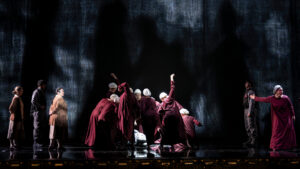
In Conversation with Poul Ruders: On Composing The Handmaid’s Tale
What does it mean to translate a dystopian novel into sound? Ahead of Detroit Opera’s production of The Handmaid’s Tale, composer Poul Ruders shares insights into the musical language of the opera, his approach to building the world of Gilead, and the ways the work continues to resonate with audiences decades after its premiere. Read the full Q&A below.
When you first read Margaret Atwood’s novel, what struck you most viscerally, and how did that translate into the sonic language of your opera?
It struck me, about halfway through reading the novel, that should I ever write an opera again (I’d written one, back in 1987, Tycho, which bombed spectacularly, leaving me with a less than lustful appetite for tackling a new one), Margaret Atwood´s The Handmaid´s Tale was operatic gold, a plethora of drama in countless guises: forbidden love, emotional inner strength (Offred) in the face of brutal oppression, a lost child, sexual perversion, colorful processionals, public executions, religious fanaticism, hypocrisy and ultimately hope—political and personal.
The opera has such a distinctive and unsettling sound world. How did you musically construct Gilead? Were there specific compositional techniques, harmonies, or orchestral colors you chose to evoke that dystopian reality?
Yes, the score is mostly quite savage, at times even unpleasant listening, which is why the piece isn’t universally loved, there’re people out there who hate the relentless onslaught, the screaming Aunt Lydia and the pounding pacing. But so be it, Gilead is a terrible place, and the best way to let the audience feel the oppression would—for me at least—be to let them get a whiff of the “squeeze” through the music. All the same, because the story jumps back and forth in time, in the scenes, mostly harmless domestic episodes from the time before Gilead, the music changes on a dime, switching from militaristic brutalism to the happy-go-lucky near musical like carefree natter.
Offred’s interior narration is the engine of the novel. How did you think about “interiority” in opera—what can music reveal that text can’t?
Music is sound and as such easy to manipulate, as it were. One (in this case the composer) controls the emotional volume through written dynamic indications in the score. The softer the volume and the lower the pitch, the more the “interiority” becomes obvious to the listener. It´s terribly banal, but it works.
Did you build recurring motifs or harmonic “signatures” for characters (Offred, Serena Joy, the Commander), or for systems (Gilead itself)? If so, how do they transform over the course of the opera?
The ever present “leitmotif” in the opera is of course “Amazing Grace,” a gospel song/hymn about hope and reconciliation (written in 1789 by a reformed British Navy Officer John Newton, regretting and atoning for his former involvement in the British slavetrade).
Serena Joy, the wife of Commander Fred, used to be a Television Gospel singer in the old days. Now, in Gilead, music is forbidden, but she still relives the time of her former glory as a revered public figure. I chose to let the music, “Amazing Grace” embrace and represent the hypocrisy permeating the whole of the theocratic tyranny of Gilead. Most blatantly, needless to say, when Offred is lying supine on top of Serena, being raped by Commander Fred, and I unleash that, the sweetest of tunes, to the accompaniment of full orchestra and jubilant background chorus.
Are there particular instruments or registers you think of as the “sound” of surveillance, authority, or obedience? (And conversely: what sounds represent memory, tenderness, or private thought?)
I´d say that the occasional background chant by the male chorus, visible or invisible, represents the ubiquitous surveillance typical of all repressive regimes.
When you composed The Handmaid’s Tale in the late 1990s, did you have any sense that the novel would become even more culturally and politically resonant decades later?
No, not at the beginning, but during the composition of the piece, which I began in 1996, it became obvious that the rise of the Taliban in Afghanistan with its atrocious oppression of women, especially the draconian ban of their right to basic education, books and general knowledge, appeared uncannily close to The Handmaid´s Tale. Ms. Atwood has later revealed that she took great care only to include events and atrocities that had already occurred somewhere, sometime in the course of human history.Homo Sapiens is really capable of the … unimaginable.
Has audience response to the piece changed over time, especially given the renewed global attention to the story?
I wouldn´t know, really. The opera enjoyed a near sensational reception following the premiere in Copenhagen, 6 March 2000. It played at ENO and Minneapolis in 2003 and in Toronto, at the COC in 2004. Then it died, or at least went into hibernation for 20 years.
Then the Hulu TV series happened, which not only catapulted the novel into literary stardom, Margaret Atwood became a household name, and the opera? Well, it didn´t take long before performances almost mushroomed, all over the place, starting with the Melbourne Summerfestival, 2018. Now there´s at least one production a year, somewhere.
Will it last? I don´t know, but unfortunately the timeliness of the story keeps the opera alive. But frankly, I´d happily trade that success in for a better world.
Many of the women’s roles are mezzos or altos (for example: Offred, Serena Joy, Rita), and it’s not often that the main female protagonist is written for a mezzo. Can you tell us how and why you came to these decisions?
Offred tells her story, somewhere in hiding, clandestinely, so it was obvious to present most of the female cast in a way not blatantly in the high-pitched forefront. Moira, though, is a feisty rebellious soprano, and Aunt Lydia, the hateful Red Center enforcer and chief whip, of course she´s screaming her head off, spitting her animosity at the terrified Handmaids, enjoying her newly acquired power. I see Lydia as a weak person with a grudge, but now she has been given power and a uniform. And that always means trouble…
When you compose, do you do so at a piano? What is your process? Do you start with a general soundscape and build onto it with instrumentations; or start with text and build around that; or, some other method?
I can easily compose away from the piano, being able to “hear what I see” when writing the notes. But, especially when writing opera, playing through the daily “production” appearing on the music sheets, is both useful and enjoyable.
And, needless to say, I need the text, the libretto, otherwise I wouldn´t know what to set music to. And goodness me, what a succulent morsel of a libretto I had from Paul Bentley!
Who do you consider to be your biggest influences compositionally?
For opera? Puccini, Strauss, Alban Berg … and whatever hits me on the trot. I´m a shameless gobbler-up of outside influence. Anything will do, also film, books.
What do you hope lingers after the final curtain: a character’s humanity, a warning, a question, a specific sound?
A warning … with hope.
Poul Ruders’ The Handmaid Tale is at Detroit Opera March 1 – 7, 2026. Tickets available here.
RELATED POSTS
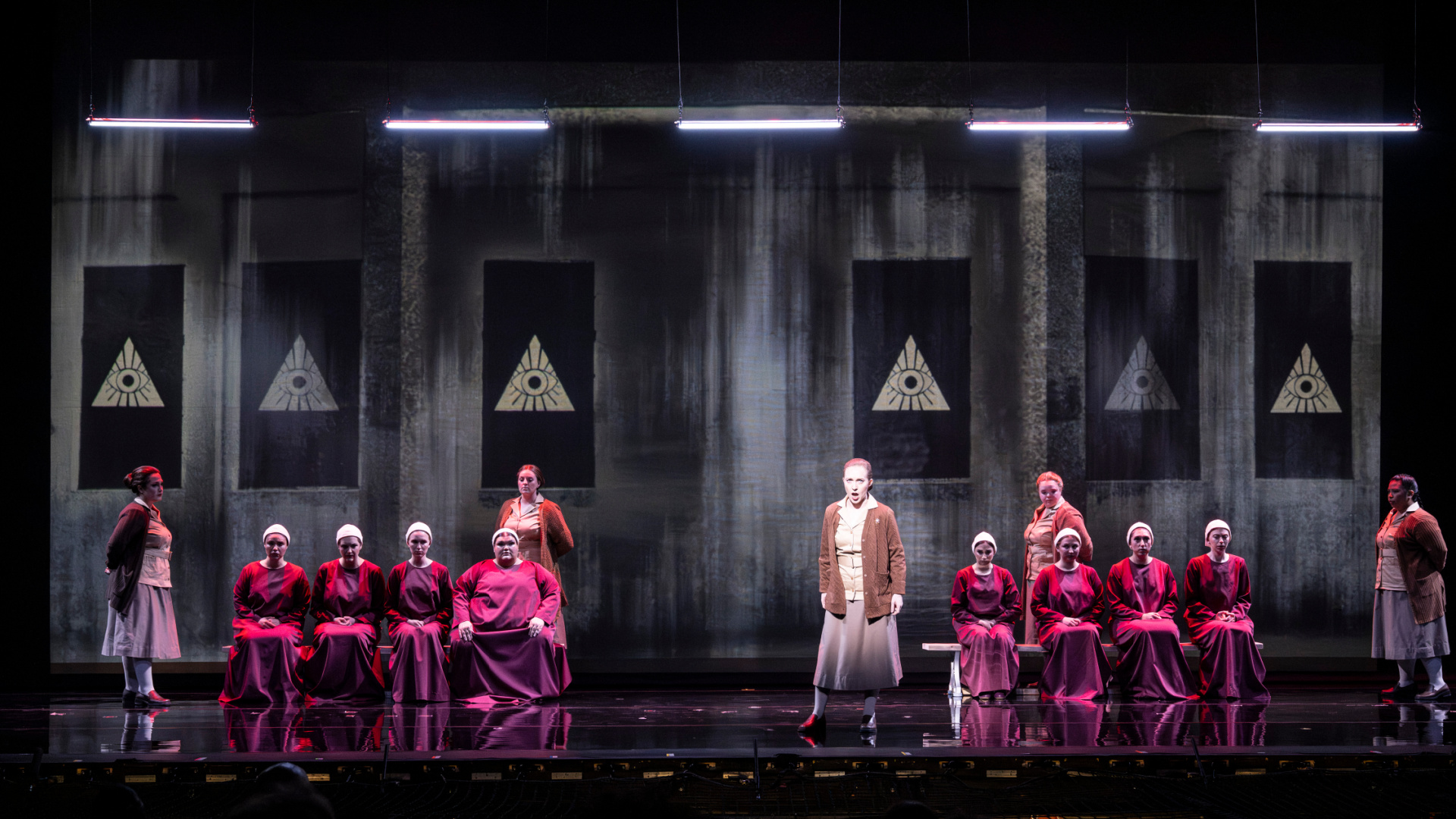
Opera, Pop Culture, and Why The Handmaid’s Tale Already Has a Fandom
Opera, Pop Culture, and Why The Handmaid’s Tale Already Has a Fandom By Austin T. Richey, Ph. D. Digital Media Manager and Storyteller, Detroit Opera Women dressed in red gowns protest outside the Department of Homeland Security Cybersecurity Summit in Manhattan, New York, July 31, 2018. Shannon Stapleton / Reuters. Long before a single note of The Handmaid’s Tale is...
learn More
When Dystopia Stops Feeling Like Fiction: Opera as a Mirror of the Present
When Dystopia Stops Feeling Like Fiction: Opera as a Mirror of the Present Opera has never shied away from tyrants. By Austin T. Richey, Ph. D. Digital Media Manager and Storyteller, Detroit Opera The Central Park Five at Detroit Opera, 2025. Austin T. Richey / Detroit Opera. Across centuries of repertoire, power appears...
learn More
PROGRAM: The Handmaid's Tale
Enjoy the performance program from the convenience of your phone! All the information contained in the program book is at your fingertips. Click below for the full experience.
learn More
Free Community Events - The Handmaid's Tale
Join Detroit Opera for a series of free community events leading up to The Handmaid’s Tale. Moderated discussions with local experts will explore key themes from the opera — including female disempowerment, reproductive rights, and control—examining how patriarchal systems use religious extremism and political power to oppress women, as well as themes of survival, memory,...
learn More