
John Cage’s Detroit: Early Years
By Austin T. Richey, Ph. D.
Digital Media Manager and Storyteller, Detroit Opera
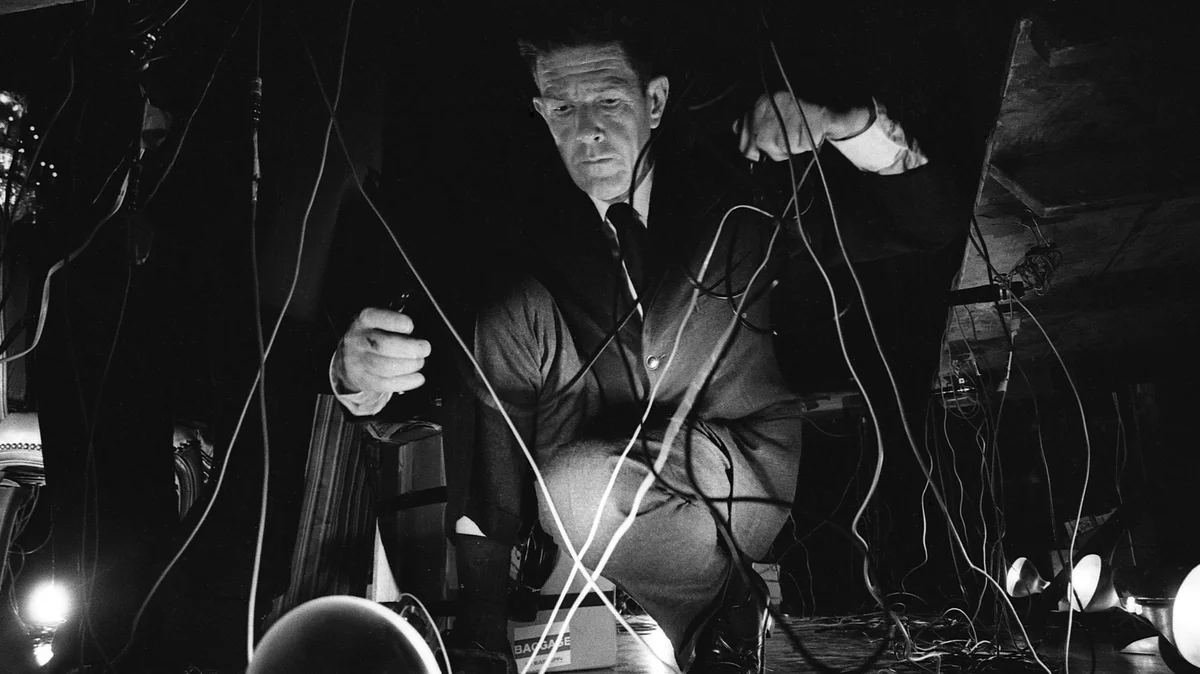
John Cage during his 1966 concert at the opening of the National Arts Foundation in Washington, D.C. Image: Rowland Scherman / Getty Images.
“The first question I ask myself when something doesn’t seem to be beautiful is why do I think it’s not beautiful. And very shortly you discover that there is no reason.”
— John Cage
John Cage was a composer, visual artist, and innovator who changed the course of contemporary art music in the 20th century. Through concepts like indeterminacy—that is, letting go of the compositional process and allowing chance to determine musical outcomes—and his obsession with silence, most infamously evident in 4’33”, Cage provoked questions about the role of music, and art itself, in a modernizing world. His early artistic years in California and his emergent success in New York City’s downtown scene in the mid-1900s have been the main focus for many biographers and scholars. Yet little attention has been paid to Cage’s Michigan years as a young boy, and later, as an established leader of the American avant-garde. His work has had an enduring impact on the cultural landscape, and soundscape, of the city of Detroit.
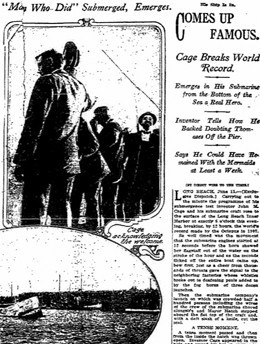
“Comes Up Famous,” Los Angeles Times, June 12, 1913. Credit: Los Angeles Times.
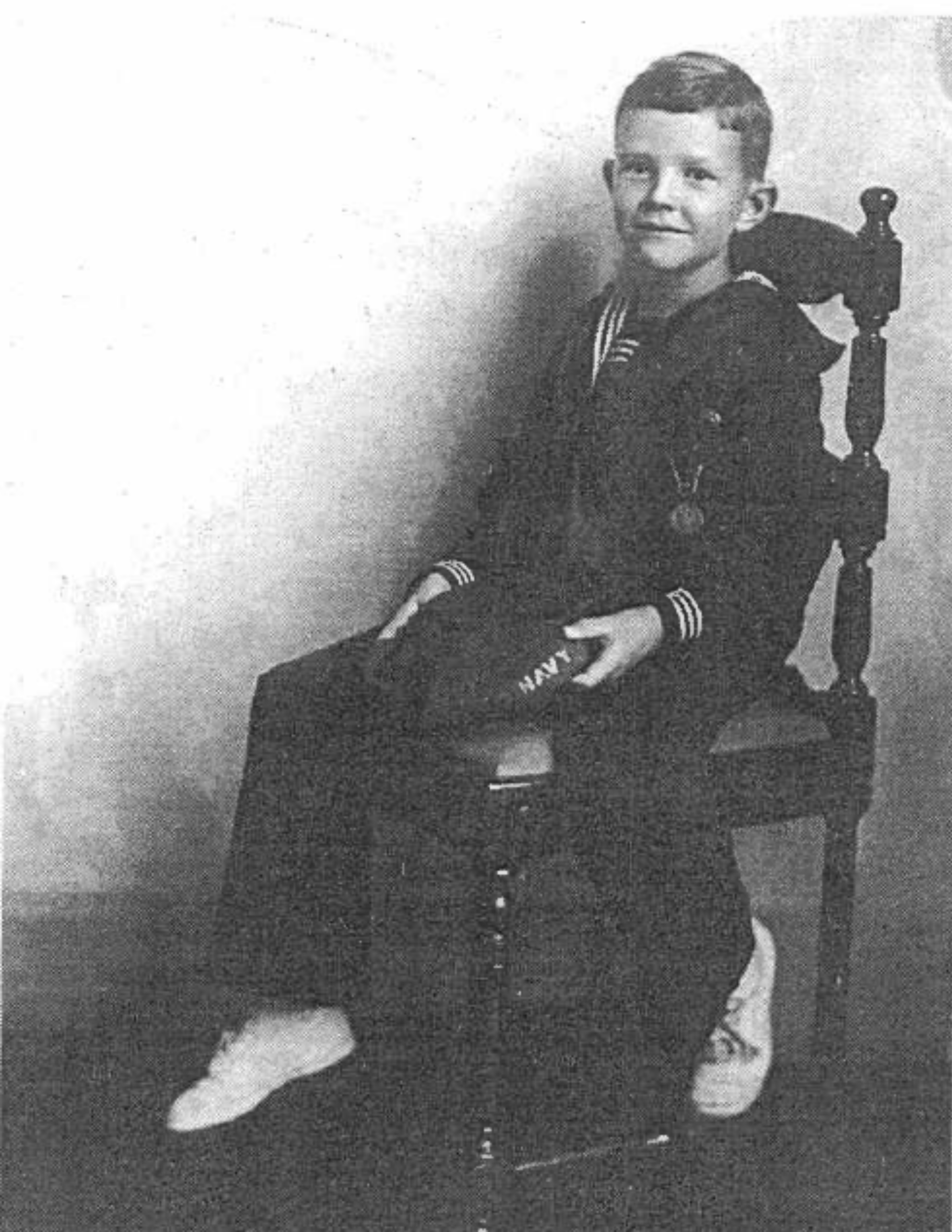
Cage in Detroit (c. 1921), from John Cage at Seventy-Five. Photo: The John Cage Trust.
Cage was born on September 5, 1912, in downtown Los Angeles. His father, John Milton Cage, was an inventor, made famous by the unlikely triumph of his gas-powered submarine. During World War I he was instrumental in creating the hydrophone—an amplification device that can pick up sound waves underwater—and during World War II the sonobuoy, a small submersible that, with a network of other sonobuoys, created a complex sonar system. His mother, Lucretia “Crete” Cage, was a burgeoning club woman and a member and leader of women’s social clubs throughout her life. These clubs were originally established as part of the women’s suffrage movement, but after the 19th Amendment was ratified in 1920, their focus shifted toward establishing the power of women in everyday American society.
In 1919, the Cage family moved to Detroit. Based on the national recognition brought on by his submersible success, Cage Sr. joined the engineering department at the University of Michigan and became a consultant for the automotive industry. The family first lived in the Stevenson Hotel on Davenport Avenue.
As Cage recalled:
“My father was an inventor. He was able to find solutions for problems of various kinds, in the fields of electrical engineering, medicine, submarine travel, seeing through fog, and travel in space without the use of fuel. He told me that if someone says ‘can’t’ that shows you what to do. He also told me that my mother was always right even when she was wrong.”
In Detroit, Cage Sr. quickly found work in the automotive industry. His innovations with internal-combustion engines got the attention of local manufacturers, and in 1916 and 1917 he patented two major improvements in slide valve arrangements—variations on Cage’s inventions are still used today. However, it is important not to overlook Cage Sr.’s own sonic innovations. In his 1964 New York Times necrology, “John Cage, Invented Submarine Devices,” we learn that he was instrumental in the creation of the hydrophone during World War I and the sonobuoy during World War II.
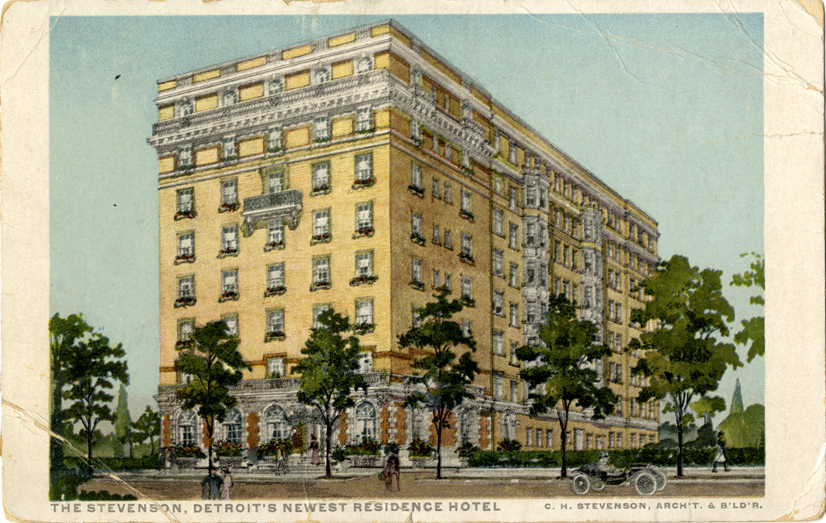
View of the Stevenson residence hotel. Detroit Publishing Company. Image: Burton Historical Collection, Detroit Public Library.
Music came early for John Cage. He began taking piano lessons from family members and private teachers in fourth grade, around 1921. Cage’s mother was most likely his first piano teacher. Growing up in Colorado, Crete regularly played for Protestant services. In Detroit, however, she found a new calling in the promising second wave of American women’s clubs. These organizations, which had grown out of the women’s suffrage movement, increasingly focused after 1920 on asserting the importance and power of women in civic life.
In 1919, Crete started the Detroit chapter of the Lincoln Study Club, the same year as the founding of The Women’s City Club of Detroit. As described in its bylaws, the Club aimed “to promote a broad acquaintance among women through their common interest in the welfare of the city of Detroit, and the state of Michigan; to maintain an open forum where leaders in matters of public important civic interest may be heard frequently, and to provide a club house where its members may meet informally.”
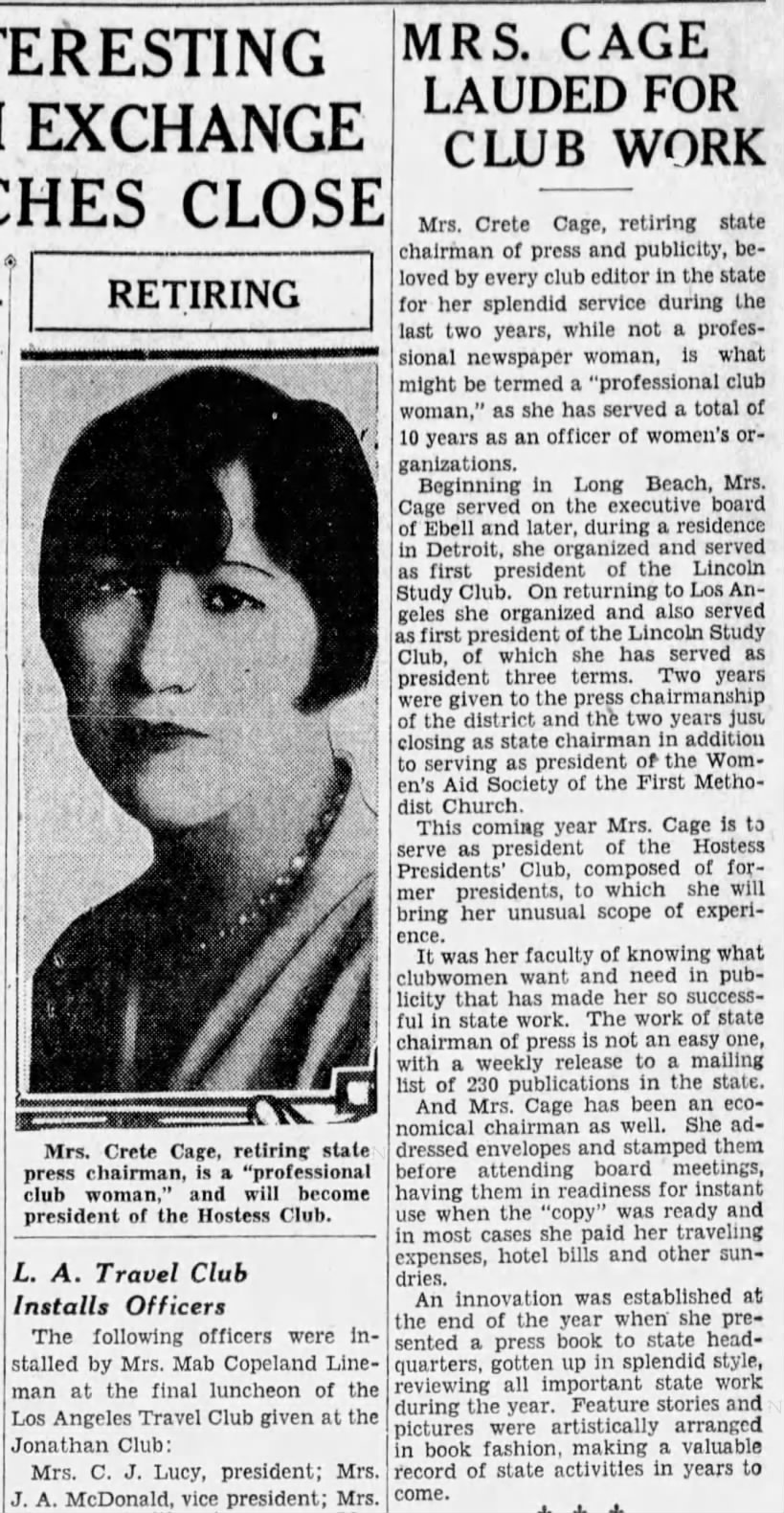
“Mrs. Cage Lauded for Club Work,” Los Angeles Evening Express, 1931.
Crete and the other members hosted lecturers, debates by Wayne State University students, and musical events at the Club, first located at 141 Bagley Avenue. Like her husband, Crete’s accomplishments garnered national attention. In 1928, she was listed in Women of the West, a biographical dictionary of influential women.
As Cage recalled:
“My mother had a sense of society. She was the founder of the Lincoln Study Club, first in Detroit, then in Los Angeles. She became the Women’s Club editor for the Los Angeles Times. She was never happy. When after Dad’s death I said, ‘Why don’t you visit the family in Los Angeles? You’ll have a good time,’ she replied, ‘Now, John, you know perfectly well I’ve never enjoyed having a good time.’ When we would go for a Sunday drive, she’d always regret that we hadn’t brought so-and-so with us. Sometimes she would leave the house and say she was never coming back. Dad was patient, and always calmed my alarm by saying, ‘Don’t worry, she’ll be back in a little while.’”
With all this professional and personal success, what caused the Cage family to return to California? As Thomas Hines writes in John Cage: Composed in America, the bright prospects of a future in Detroit were destroyed by a garden accident:
“One spring day in the early 1920s, the senior Cage climbed up into a blossoming fruit tree to cut a branch of blossoms for his wife. Through a slip of the knife, he cut himself seriously, nearly severing his wrist. This greatly curtailed the type of work he was doing in Michigan and the family returned to Southern California.… Here [he] continued, despite the lame arm, to work as an engineering consultant while carrying on his own independent experiments.”
These early years—growing up among the engines of the auto industry and the conversations surrounding women’s rights—undoubtedly shaped the young Cage. Decades later, in 1944–45, John Cage wrote a pair of short piano solo compositions dedicated to his parents, titled simply “Crete” and “Dad.” The music in both pieces is similarly sparing.
Listen:
“Crete,” John Cage, perf. Steffen Schleiermacher
“Dad,” John Cage, perf. Steffen Schleiermacher
Cage remained in California throughout the 1920s, graduated as valedictorian of Los Angeles High School, and began studies at Pomona College in 1928. Unsatisfied with the education he was receiving, he dropped out and traveled to Paris, where his dreams of becoming a writer gave way to a desire to compose music. Returning to California, he studied composition with Arnold Schoenberg in the 1930s. For more on this period of Cage’s life—including his connections with Henry Cowell and Lou Harrison, his developing artistic and personal relationship with Merce Cunningham, and his move to New York City—read Rob Haskins’s excellent biography John Cage. In our next blog post, we will look at Cage’s later work in Michigan, including performances at Music Hall Detroit, Ann Arbor’s Hill Auditorium, and workshops at Cranbrook Art Academy and Interlochen Center for the Arts.