November 1-7, 2026
Tosca
A perfectly constructed political thriller.
Music by Giacomo Puccini
Libretto by Luigi Illica & Giuseppe Giacosa
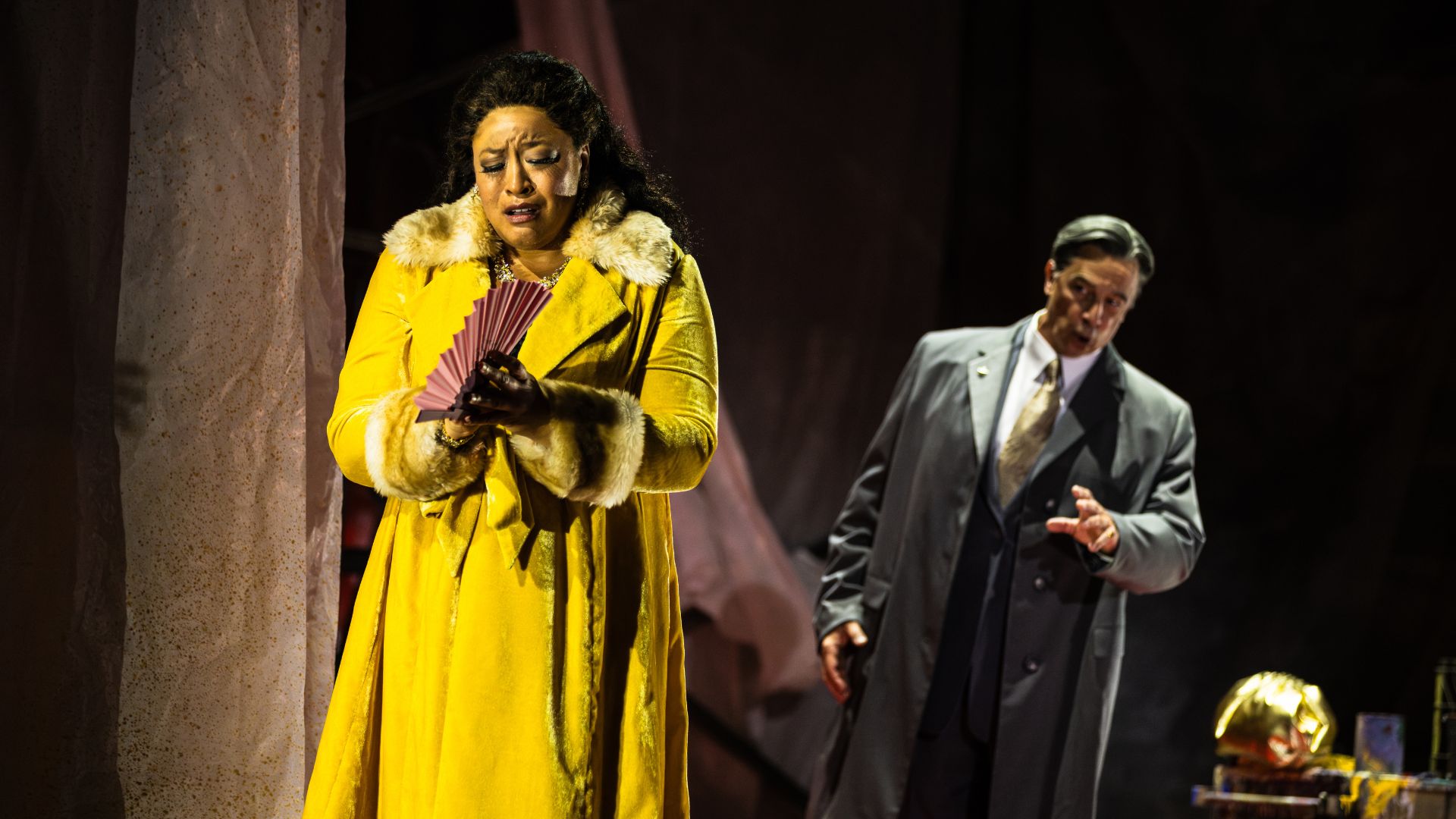
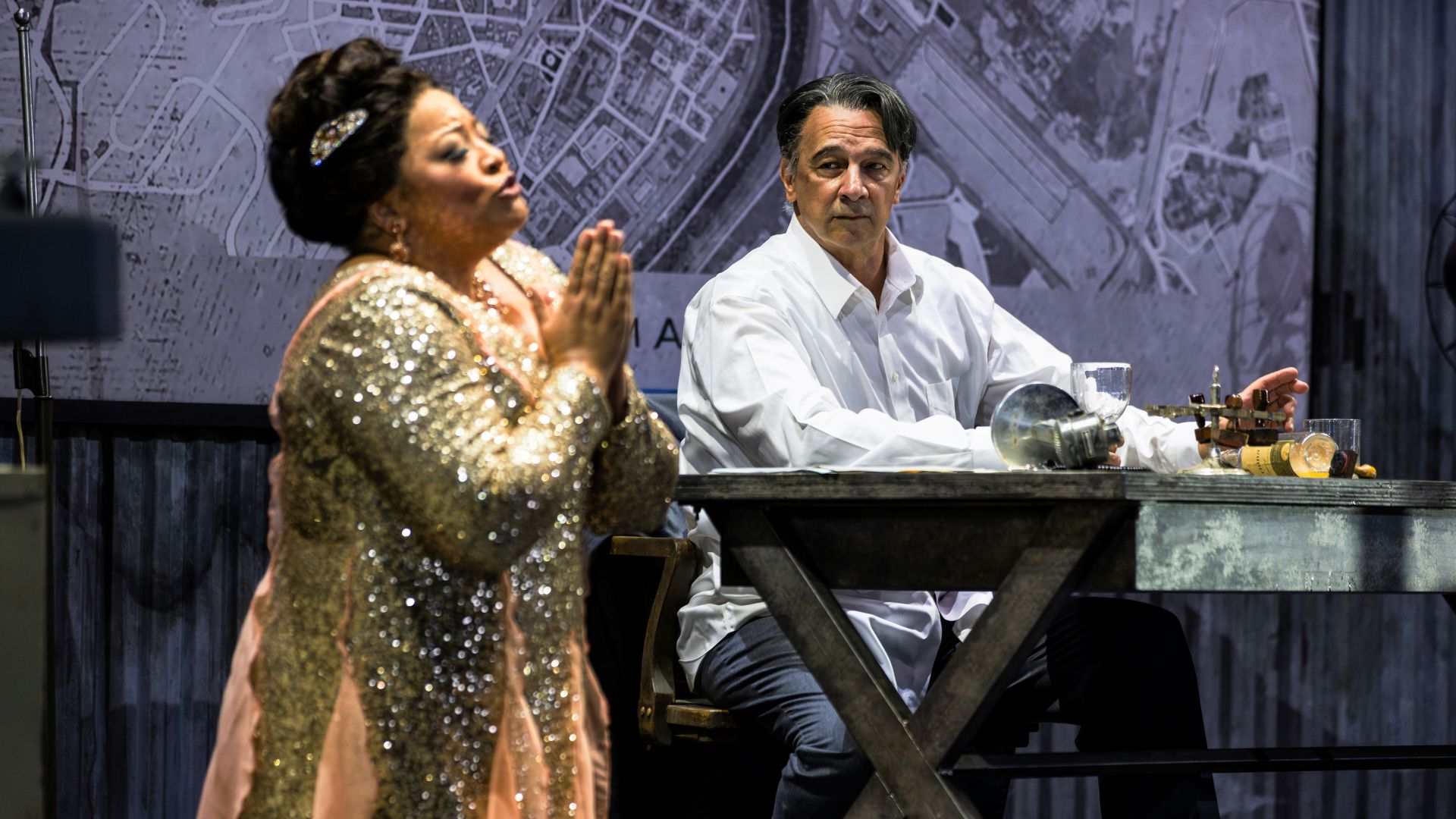
Tosca, a tempestuous diva, lives for art—and for love. When Cavaradossi, her lover and a revolutionary painter, is targeted by Rome’s corrupt chief of police, Tosca is determined to save him—but at what price? Puccini’s lush score, written on the heels of La bohème, contrasts moments of exquisite tenderness with heart-stopping sonic spectacle.
From the Dramaturg’s Desk: A Deep Dive into Tosca
Director’s Note by Louisa Proske
Tosca is a perfectly constructed political thriller, full of hair-raising suspense, with complex and dazzlingly extreme characters who are involved in betrayals, double crossings, and as twisted a cat-and-mouse game as any John le Carré novel could imagine. The opera has its own rich political consciousness, and, what is more, self-consciousness. Being a work of art, written and performed by artists about artists, it asks: What is the role of an artist in an authoritarian regime? Can you make art during times of political repression? Should you leave or should you stay? And when does staying and working inside a political reality, the implicit acceptance of the terms, turn into collusion?
These questions, unfortunately, became existential for artists all over the world in murderous dictatorships and fascist regimes of the century following Puccini’s own. Dictators who sought to establish their propaganda as the supreme truth, the only solution, understood that the artist’s ability to imagine an “elsewhere,” a utopia, and to fill their work with coded criticism of power, was a threat to their survival. Maybe they also instinctively knew that while artists’ bodies can be incarcerated, beaten, maimed, and killed, their work tends to far outlive the fame of shabby tyrants dressed in a little brief authority. In the confines of a torture prison, the dictator may crush the artist, but once you think in centuries, artists survive dictators.
But artists can also suffer from myopia and miss the signs that society has slipped deeper into repression. Tosca, a woman of amazing imagination, spends a whole act believing she is in an entirely different plot—one about jealousy and romantic betrayal, not about a psychopath in power who extorts sexual favors and tortures and kills at will. Indeed, this is also the noose Puccini lays around the audience’s neck in the first act. Charmed by the love story and the sublime music it inspires, we want to forget that we’ve just seen a political prisoner so emaciated and abused that Cavaradossi doesn’t even recognize him as his comrade. It seems that Puccini was supremely aware of his music’s power to transport people, for better or worse.
Tosca’s awakening to her political reality, to the obscene horrors that happen “in the other room,” makes for the searing intensity of the second act. The etymology of “obscene”: that which happens just out of view, off stage; that which cannot be shown directly on a stage. Her long scene with Scarpia is propelled by Tosca’s extraordinary double nature: she is a creature of the theater, a passionate and exquisite prima donna—and also a deeply devout Christian woman whose religious anchorage is, like Job’s in the Bible, terrifyingly unmoored when she is placed in an impossible moral predicament. Being raped by Scarpia: the steep price for her lover’s life. Why, God, why do you repay me like this?
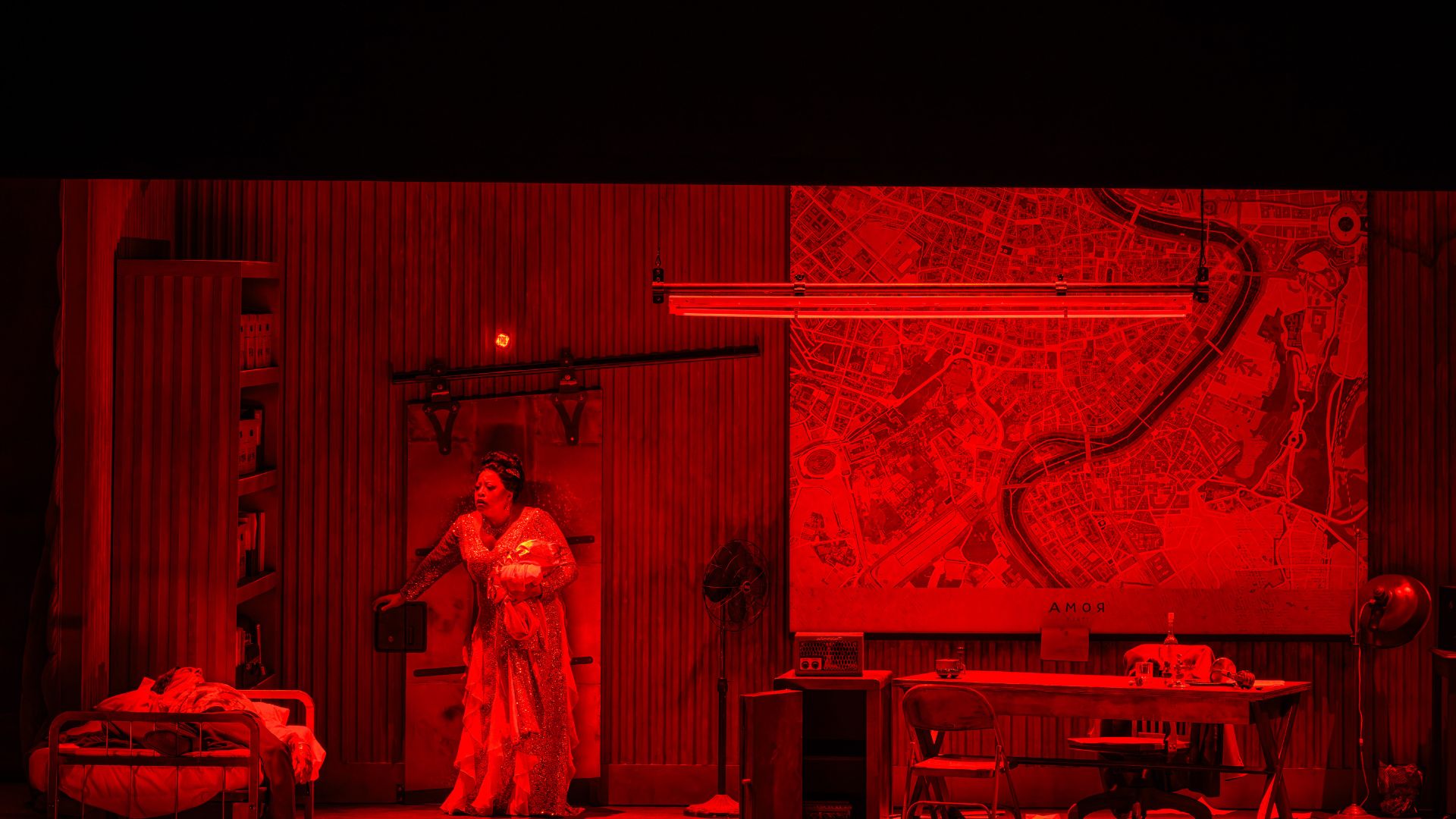
Is there an escape from Scarpia’s basement? It is at the crossroads of this question that our production opens up a new poetic space for the final act of the opera: one that deals in Tosca’s memories and visions and, in her moment of greatest despair, allows us to journey deeper into her theatrical and her religious imagination. Puccini’s coup—that Tosca believes the execution of her lover is just a piece of theater with fake ammunition and pretend death—creates an extraordinary self-awareness of the opera as an opera, and at the same time enacts the consequences of Tosca’s fundamental myopia, her inability to see the worthlessness of a deal with Scarpia whose word means nothing.
Cavaradossi and Tosca never make it out of Rome alive, but just before the end, they imagine their escape with the luminous intensity of two young artists in love: they see themselves free, sailing across the sea, spreading their art, their colors, their music, throughout the world. The irony is: they never will—but the deeper irony is that in this moment, in performing Tosca in the future year of 2025 in present day America, and in every live performance since 1900, they are doing just that—setting against the murderous cynicism of the world’s Scarpias the Utopian belief that art can transform reality. Can it? Certainly we live in a world where, according to this year’s headlines, one can be jailed for reciting a poem, flogged for singing a song, or disappeared for wearing the wrong tattoo. Enjoy the music, Puccini seems to say—but don’t lose the plot, and ignore the signs at your own peril.
Show Details
Act I: 44:40
Intermission: 25:00
Act II & III: 72:00
Total: 2h 22m
Composer:
Giacomo Puccini
Libretto:
Luigi Illica and Giuseppe Giacosa
Detroit Opera Orchestra
| Violin I | Flute | |||
| Concertmaster | Michael Ferri | Principal | Collin Stavinoha | |
| Acting Assistant Concertmaster | Yuri Popowycz | Andrea Velasquez /Piccolo 2 | ||
| Henrik Karapetyan | Dennis Carter II /Piccolo 1 | |||
| Molly Hughes | ||||
| Jenny Wan | Oboe | |||
| Nathaniel Cornell | Acting Principal | Mark Doerr | ||
| Velda Kelly | Xiaodi Liu | |||
| David Ormai | Geoffrey Johnson-English Horn | |||
| Ying-Li Pan | ||||
| Karen Donato | Clarinet | |||
| Acting Principal | Chad Burrow | |||
| Violin II | Ryan King | |||
| Principal | Emelyn Bashour | J.William King- Bass Clarinet | ||
| Bryan Johnston | ||||
| Dan Stachyra | Bassoon | |||
| Andrew Wu | Principal | Daniel Fendrick | ||
| Anna Bittar-Weller | Sarah Fluker | |||
| Mallory Tabb | Susan Nelson- Contra Bassoon | |||
| Beth Kirton | ||||
| Courtney Lubin | Horn | |||
| Acting Principal | Natalie Sweasy | |||
| Viola | Samuel Sidorowicz | |||
| Principal | John Madison -Banda | Jake Nowell | ||
| Scott Stefanko | Tamara Kosinski | |||
| Chloe Thominet | ||||
| Jacqueline Hanson | Trumpet | |||
| James Greer | Acting Principal | Scott Thornburg | ||
| Julianne Zinn | Elijah Leonard | |||
| Derek Lockhart | ||||
| Cello | ||||
| Principal | Ivana Biliskov | Trombone | ||
| Benjamin Maxwell | Principal | Jordan Dove | ||
| Andrea Yun | Dustin Nguyen | |||
| Sarina Zhang | Bryan Pokorney-Bass Trombone | |||
| Sarah Cleveland | ||||
| Sabrina Lackey | Cimbasso | |||
| Acting Principal | David Zerkel | |||
| Bass | ||||
| Principal | Derek Weller | Timpani | ||
| Clark Suttle | Principal | Eric Stoss | ||
| Jean Posekany | ||||
| Alex Zajdel | Percussion | |||
| Principal | John Dorsey | |||
| Harp | David Taylor | |||
| Principal | Juan Riveros | Jason Ihnat | ||
| Beth Henson-Banda | ||||
| Organ/Celeste | ||||
| Acting Principal | John Etsell |
-
Performance Dates & Times:
SUN / NOV 1, 2026 / 2:30 PM
THU / NOV 5, 2026 / 7:30 PM
SAT / NOV 7, 2026 / 7:30 PM
-
Place:
Detroit Opera House
1526 Broadway St
Detroit MI